


Is Agentic AI Reliable Enough for Identity Automation Across Apps Without SSO, SCIM, or APIs? 5 Areas to Evaluate
The rise of agentic AI introduces new potential for identity security, especially in automating integrations with disconnected apps. The promise is compelling: an AI agent can build and run workflows on your behalf with no need for costly custom development or professional services.
But while AI demos may be fast, seamless integrations and real enterprise environments are rarely that predictable. Identity workflows span apps that change frequently, fail unexpectedly, and behave inconsistently. The real challenge is developing, running, and maintaining a workflow reliably, securely, and at scale.
Independent research from the Ponemon Institute found that, on average, 30% of enterprise applications sit outside centralized identity systems. And 40% of those disconnected apps are business-critical. In the same study, 77% of organizations reported at least one cybersecurity incident tied to disconnected apps in the past two years.
This guide outlines what to evaluate when assessing agentic AI solutions for disconnected apps. We’ll help you understand where a purely agentic approach falls short, when human-in-the-loop support is still needed, and how to choose an architecture designed for the real-world complexity of enterprise app environments.
Why the right architecture matters
A purely agentic AI approach gives a single agent responsibility for both creating and executing workflows, without human-in-the-loop support. While appealing in theory, this architecture introduces risk, fragility, and operational inefficiencies in real-world identity security environments. Below are five key areas buyers should evaluate to understand whether an agentic AI solution is ready for enterprise scale.
What to evaluate
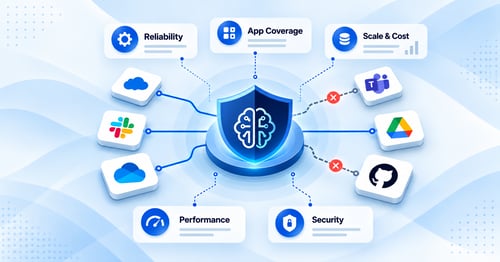
Evaluate any agentic AI solution across five areas:
- Execution method: Is workflow execution deterministic and repeatable, or probabilistic and prone to silent failures on critical identity tasks?
- Application coverage: Does it reach beyond the browser to on-prem thick clients, mobile, and custom internal apps, or only the easy-to-automate web apps?
- Scalability and cost: Can it run daily syncs across thousands of users without compute and token costs becoming prohibitive?
- Performance: Can it process large user sets with predictable speed, or do reasoning-heavy steps turn routine jobs into multi-hour or multi-day runs?
- Security readiness: Can it handle MFA and multi-step logins and pass bot-detection systems without disabling your controls?
Is agentic AI reliable enough for provisioning and deprovisioning?
Probabilistic does not equal reliable.
Agentic AI systems are probabilistic by nature. Rather than following a fully mapped sequence of steps, the agent “reasons” through workflows at runtime, guessing the next best action based on training data.
This approach is especially risky in identity lifecycle management (LCM), where tasks like provisioning, deprovisioning, and access updates require accuracy and predictability. When a probabilistic agent encounters an unpredictable application UI, such as a renamed button, a missing field, or a pop-up error, workflows can break silently or take the wrong action entirely.
Can agentic AI reach apps beyond the browser?
Browser-based solutions aren't enough.
Many agentic solutions are limited to automating interactions in a web browser environment. While this may cover a portion of your app landscape, it excludes a wide range of critical systems, including on-premises thick clients (desktop apps), mobile apps, and custom-built internal apps. If the agent can't interact with these systems, it leaves critical identity and governance gaps.
A modern identity security solution must reach the full ecosystem, not just the apps that are easiest to automate.
How much does agentic AI cost to run at enterprise scale?
AI agents can strain budgets and performance. They require compute cycles, inference costs, and API token usage to process large data sets or run frequent sync jobs.
These demands can be significant, and in many cases, the costs are passed directly to customers, making the solution cost-prohibitive at scale. Costs can add up fast:
- Running daily syncs across hundreds of apps and thousands of users can cost tens or even hundreds of thousands of dollars per year.
- Unlike deterministic systems, agentic agents must reason through each step, which slows execution and increases infrastructure overhead.
- Latency, timeouts, and slow throughput (for example, paginated user lists) can turn routine identity operations into multi-hour or multi-day jobs.
A solution that can't operate cost-efficiently under load becomes a blocker, not a bridge, for identity workflows. You need confidence that performance is predictable and that costs remain sustainable as you scale.
Separately, the Ponemon study found that 52% of organizations use automation workarounds to manage disconnected apps. Those teams spend an average of 31.2 staff hours per week fixing the tools when application updates or interface changes break them.
Is agentic AI fast enough for daily identity syncs?
Slow agents can't keep up.
Agentic AI isn't just expensive. It's often slow. Because of their non-deterministic nature, AI agents must reason through each step of a workflow in real time, which adds latency at every turn. The time it takes to process thousands of records can easily stretch into hours or even days, making daily synchronization, a core requirement for identity management, impractical. Timeouts, partial failures, and inconsistent performance are common, especially at enterprise scale.
If your agent can't operate with predictable speed, it stops driving value and starts becoming an operational bottleneck.
Can agentic AI handle MFA and bot detection without weakening security?
Authentication, MFA, and bot detection can break agentic workflows.
Authentication is where most agentic systems run into real-world friction. A solution must do more than execute a workflow. It must do so securely, respecting your existing controls and avoiding detection by anti-bot systems.
- MFA and authentication: The agent needs to authenticate itself to carry out its task. Can the solution handle proprietary MFA methods, such as a virtualized soft token or a multistep authentication flow? If the agent can't log in securely, the workflow is dead on arrival.
- Navigating bot detection: As bots become more common, sophisticated bot-detection solutions (like those from Cloudflare) increasingly block non-human identity traffic. A basic agent running from a headless browser will be detected and blocked. The solution must run the workflow intelligently, so it convincingly appears human.
A scalable identity solution must log in, authenticate, and run workflows without compromising controls or raising red flags with detection systems.
Ponemon also found that 55% of organizations rely on password-only authentication for disconnected apps, with no MFA. Any automation that requires disabling MFA would widen that gap.
Agentic AI due diligence checklist: 7 questions to ask any vendor
Use this checklist to pressure-test any vendor relying on a purely agentic approach. The five evaluation areas above break down into seven questions to ask your vendor.
| Critical consideration | Question to ask your vendor | Your business risk |
|---|---|---|
| Execution architecture | Is the AI agent used for both creation and direct execution? How predictable and safe is the AI's behavior during workflow execution, especially for sensitive identity flows like LCM? | Unpredictable outcomes: Probabilistic execution introduces risk to critical LCM operations. |
| Edge case coverage | How is the agent guaranteed to handle the non-happy paths (e.g., existing user, permission conflict) without human intervention? | Operational downtime: Workflow execution stops at the first unhandled error, requiring manual recovery. |
| Reliability under UI changes | What happens when the application UI changes? How does the agent ensure it does not take an unintended, destructive action? | Security risk/compliance: Unintended LCM operations (e.g., failed de-provisioning) could violate security policy. |
| Support for varied app types | Can the solution support more than just web apps? What about on-prem, thick clients, or mobile apps? | Incomplete coverage: Critical disconnected applications are left unsecured and ungoverned. |
| Scalability & cost | How does the system handle large-scale syncs and high-volume jobs? How long will it take your agent to synchronize 10,000 records without a CSV file? Are compute/token costs sustainable at enterprise scale? Does the vendor or customer pay this? | Cost-prohibitive operations: Routine, high-volume operations become too slow and too expensive to run daily. |
| Security & MFA | What logic is built to handle multi-factor authentication (MFA) methods like multi-step flows, proprietary soft tokens, etc.? Can it complete complex login sequences involving CAPTCHAS or pop-ups? | Security gaps: You must lower the security bar by disabling MFA to enable automation. |
| Bot detection evasion | What specific infrastructure ensures the agent can reliably bypass bot detection systems like Cloudflare or Akamai without being blocked? | Integration failure: The agent is blocked from logging in, making the integration unusable at scale. |
Prefer a PDF? Download the full buyer's guide.
Frequently asked questions
What is a purely agentic AI approach to identity automation?
It gives a single AI agent responsibility for both creating and executing workflows, without human-in-the-loop support. The agent reasons through workflows at runtime and guesses the next best action based on training data, rather than following a fully mapped sequence of steps.
Is agentic AI reliable for provisioning and deprovisioning?
Probabilistic execution is risky for identity lifecycle management, where provisioning, deprovisioning, and access updates require accuracy and predictability. When a probabilistic agent encounters an unpredictable application UI, such as a renamed button or a missing field, workflows can break silently or take the wrong action.
Can agentic AI automate apps that aren't browser-based?
Many agentic solutions only automate web browser interactions. That excludes on-premise thick clients, mobile apps, and custom-built internal apps. A modern identity security solution must reach the full ecosystem, not just the apps that are easiest to automate.
Why is agentic AI expensive and slow at scale?
Agents require compute cycles, inference costs, and token usage, and must reason through each step in real time. Daily syncs across thousands of users can cost tens or even hundreds of thousands of dollars per year, and processing large record sets can stretch into multi-hour or multi-day jobs.
Can agentic AI handle MFA and bot detection?
Authentication is where most agentic systems hit friction. The solution must handle proprietary MFA methods and multistep logins, and run in a way that passes bot-detection systems like Cloudflare, without forcing you to disable your security controls.