
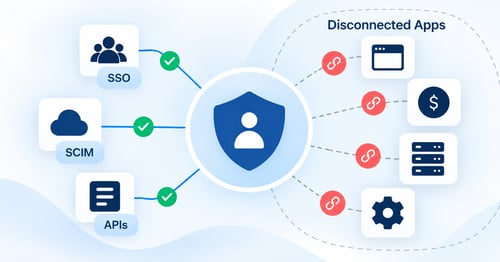


Disconnected applications are one of the biggest blind spots in enterprise security. These are apps that can’t easily plug into your organization’s identity management systems because they don’t support federated authentication like SAML or OIDC and may lack SCIM or APIs. The risk shows up across four key areas: credential management, authentication, identity automation, and logging and auditability.
Most teams try to address this risk with password managers, manual processes, scripts, RPA, and iPaaS. Each approach leaves gaps. Cerby was purpose-built for this problem. It automates the full identity lifecycle for disconnected apps, even the ones with no API. Customers report 280% ROI and 90% automation of identity workflows. In this article, we explore this problem more deeply and how to manage your own non-federated apps.
What are disconnected apps?
Most organizations assume their identity program covers everything. Or they accept the gap that exists until a problem, breach, or failed audit occurs.
Disconnected apps are the ones your IdP can’t easily reach. Not because you made a configuration mistake, but because those apps were not designed to support the standards your stack relies on. They don’t support federated authentication like SAML or OIDC and may lack SCIM or APIs for automation. They’re not just old on-prem tools, either. Many modern SaaS platforms in marketing, finance, and social media fall into this category, and the number keeps growing.
Disconnected apps are systems that:
- Aren’t managed by IT or security in an automated, centralized way
- Don’t support federated authentication like SAML or OIDC
- Use credentials such as usernames, passwords, and sometimes MFA codes for access
- Lack support for SCIM or even APIs for automation
For example, marketing teams rely on social media platforms like Meta, X, TikTok, and LinkedIn. Finance teams use banking and payment systems, and operations teams often depend on on-prem data tools. Disconnected apps exist in nearly every function and introduce unmanaged risk.
Cerby's 2026 Ponemon Institute research found that, on average, 30% of enterprise applications are disconnected from centralized identity systems, and 40% of those are business-critical. At a typical estate of 284 applications, that’s more than 80 apps your identity program can’t see, and roughly 32 of them are business-critical.
- 77% of organizations experienced at least one cybersecurity incident tied to disconnected apps in the past two years
- 63% failed an internal or external audit at least once because of gaps in securing them
- 58% say the number of disconnected apps rose in the past 12 months
Why your identity provider can't reach disconnected apps on its own
Your identity provider is doing exactly what it was designed to do. Standards like SAML and SCIM are widely recognized, but many enterprise apps don’t support them. Your IdP secures the front door for the apps that speak its protocols. But some apps don’t, so they fall through: no federated login, no automated provisioning or deprovisioning, no enforced MFA, and no centralized logging. The gap isn’t a flaw; it’s just how IdPs are built.
This is the gap Cerby closes. Cerby integrates with Okta and Microsoft Entra ID to extend identity workflows to disconnected apps, including SaaS, legacy, on-prem, and homegrown applications. Here’s how Cerby does it:
- SSO-like access for disconnected apps. Users can launch disconnected apps directly from their existing Okta or Microsoft Entra ID dashboards, creating an SSO-like experience.
- Provisioning and deprovisioning triggered by identity provider events from platforms like Okta or Microsoft Entra ID.
- Centrally managed MFA for disconnected apps, including support for organization-owned MFA factors on shared accounts.
- Policy-based authentication controls, including login-only mode so users can sign in without seeing or copying passwords.
- Centralized logging and direct integration with SIEM tools for monitoring disconnected app activity.
The four areas where disconnected apps create risk
The gaps show up everywhere, all at once.
| Aspect | What's at stake | Typical problem in enterprises |
|---|---|---|
| Credential Management | How passwords and secrets are created, stored, and shared | Weak, reused, or shared credentials handled insecurely |
| Authentication | How users log in and whether MFA is enforced | Users manage their own credentials; MFA is often disabled |
| Identity Automation | How users are provisioned and deprovisioned | Former employees keep access |
| Logging and Auditability | Whether access is tracked and auditable | No centralized visibility or logs |
How do organizations typically respond?
Most IT and security teams try one of three approaches, and each leaves gaps.
- Denial or do nothing. Some teams insist they only allow apps that support SAML and SCIM. Others let employees use whatever tools they want. In both cases, shadow IT thrives. Employees create accounts, manage passwords themselves, and share credentials via chat or email. MFA enforcement is optional, and IT has no visibility.
- Manual effort. Other organizations try to manage disconnected apps through ticketing systems, spreadsheets, or email coordination. It’s inefficient, error-prone, and scales poorly.
- Automation attempts that don't scale. Some use RPA, custom scripts, or iPaaS tools to automate tasks. But these are brittle, at best. When an API or user interface changes, the automation breaks. Maintenance is expensive, and many apps still remain unmanaged.
The pattern is always the same: partial coverage, growing exceptions, and an expanding list of apps no one fully watches.
This guide compares how IT and security teams handle disconnected apps across credential management, authentication, identity automation, and logging and auditability, and shows how Cerby delivers complete coverage and automation at scale.
How do you manage credentials for disconnected apps?
Cerby's 2026 Ponemon Institute research found that the most cited risks in disconnected environments are excessive privileges (54%), users retaining access they no longer need (49%), and orphaned or dormant accounts (36%). For disconnected apps, passwords are often the only authentication method. That makes credential management the foundation everything else sits on, and one of the hardest things to govern at scale. So what do you do?
What most teams try
- Do nothing (users self-manage). Employees create and manage credentials on their own. Passwords are reused across apps, shared credentials circulate through unsecured channels, and no one has centralized control or tracking. Former employees often retain access indefinitely because revocation is never enforced.
- Enterprise password managers (EPMs). EPMs improve security by storing credentials in encrypted vaults and enforcing stronger password policies. For disconnected apps, they only solve part of the problem: no automated rotation or revocation, no integration with provisioning or deprovisioning workflows, and shared accounts may still require manual management.
What Cerby does differently
Cerby was purpose-built for disconnected applications. It doesn’t just store credentials securely. It governs them end-to-end: centralized control over who can view, use, or share credentials; instant revocation; automated rotation and revocation when users leave or change roles; orphaned account transfer; policy-based least-privilege access; and a full audit trail.
With Cerby, users never have to see or handle a password. When someone leaves, Cerby automatically rotates credentials, eliminating lingering access and the risk of password reuse. ClickUp, for example, reduced time spent managing user access by 97% after automating this work with Cerby.
| Capability | Do Nothing | EPM | Cerby |
|---|---|---|---|
| Secure Storage | No | Yes | Yes |
| Enforced Password Policy | No | Yes | Yes |
| Secure Sharing | No | Limited | Yes |
| Automatic Rotation | No | No | Yes |
| Access Revocation | No | No | Yes |
| Admin Visibility | No | Limited | Yes |
| Audit Logging | No | Limited | Yes |
How do you handle authentication for disconnected apps?
Authentication verifies user identity and controls access. Disconnected applications that lack support for federated standards like SAML or OIDC force users to rely on manual logins and personal MFA methods. This creates inconsistent experiences, weak security, and significant exposure across the enterprise.
What most teams try
- Do nothing (user-controlled). Users create and manage their own credentials, often using weak or reused passwords stored in browsers, spreadsheets, or memory. Credentials are easy to phish, share, or steal, MFA is applied inconsistently or disabled entirely, and IT and security teams have no visibility into login events, MFA usage, or account access.
- Enterprise password managers (EPMs). EPMs improve password hygiene by securely storing credentials and autofilling login fields, but they stop short of true authentication control. Passwords remain user-managed, MFA remains user-dependent, shared accounts create friction when MFA codes are tied to personal phones or emails, and admins can’t enforce policies around how or when credentials are used.
What Cerby does differently
Cerby delivers seamless, secure, and policy-driven authentication for disconnected apps. Like an EPM, it retrieves credentials from an encrypted vault and logs users in automatically. It also integrates with identity providers like Okta or Microsoft Entra ID, letting users launch disconnected apps directly from their SSO dashboards for an SSO-like experience.
Admins can define how credentials are used, shared, and revoked, including login-only mode so users can sign in without seeing or copying passwords. Cerby also automates MFA enforcement so MFA is centrally managed rather than user-dependent.
Purpose-built for shared accounts and social media platforms. Disconnected apps like social media tools often rely on shared credentials tied to personal accounts. Cerby replaces user-owned MFA factors with organization-owned emails, phone numbers, and authenticator apps, and automatically retrieves and inputs MFA codes from these shared, enterprise-owned factors, even for complex multi-step logins.
| Capability | Do Nothing | EPM | Cerby |
|---|---|---|---|
| Automated Login | No | Yes | Yes |
| SSO via IdP Dashboard | No | No | Yes |
| MFA Enforcement | No | Limited | Yes |
| Credential Exposure Limitations | No | Limited | Yes |
| Shared Account MFA | No | No | Yes |
| Admin Visibility | No | Limited | Yes |
| Audit Readiness | No | Limited | Yes |
How do you automate provisioning and deprovisioning for disconnected apps?
Identity automation governs how users are provisioned, updated, and deprovisioned across apps. You can automate connected apps with SCIM or APIs; disconnected apps can’t, creating access sprawl and compliance risk. Without automation, former employees may retain access, orphaned accounts become breach points, and compliance requirements remain unmet.
Cerby's 2026 Ponemon Institute research found that 68% of organizations report delayed or incomplete access removal after an employee is terminated, teams that rely on automation workarounds spend an average of 31.2 staff hours per week maintaining them, and access reviews for disconnected apps take 39% more time than for connected apps.
What most teams try
- Do nothing (user-driven account creation). Business teams independently create accounts with no centralized visibility. IT and security teams cannot track who has access, accounts remain active indefinitely, unneeded subscription licenses drain budgets, and compliance is impossible to maintain.
- Manual provisioning via tickets or email. IT or app owners manually log into each app to provision and deprovision users. Provisioning is slow and error-prone, deprovisioning is often incomplete or delayed, and administrative effort grows unsustainably as scale increases.
- Custom scripts or RPA. Scripts depend on APIs, and RPA can be trained on interfaces, but scripts require ongoing maintenance and are brittle; changes to app UIs or APIs often break them, API keys are frequently stored insecurely, and when script owners leave, maintenance lapses and workflows break, creating tech debt.
- Integration platform as a service (iPaaS). iPaaS tools automate workflows via app APIs, but they are focused on general-purpose APIs, not identity. They add complexity and maintenance costs, require skilled staff to build and maintain connectors, and create tech debt when internal maintainers leave.
What Cerby does differently
Cerby was purpose-built for disconnected applications. It maintains a catalog of connectors that integrate through APIs and patent-pending UI automation, so it can reach apps with no API at all.
- Purpose-built identity automation for disconnected apps. Cerby maintains a catalog of connectors that integrate with disconnected applications through both APIs and patent-pending UI automation. This architecture provides continuous control and reliability, even when app interfaces change. Building on its proven UI drift detection, Cerby is advancing further with a vision-based automation engine that continuously observes application interfaces, detecting and repairing drift before it causes failures. This proactive, AI-driven approach minimizes maintenance effort, reduces technical debt, and establishes a new benchmark for resilient, long-term automation.
- Seamless integration with existing identity solutions. Cerby complements existing IAM and IGA tools by extending automated joiner, mover, and leaver (JML) workflows to disconnected apps. It listens to identity provider events from platforms like Okta or Microsoft Entra ID to trigger provisioning and deprovisioning workflows. Beyond basic account creation, Cerby also manages role assignments, permissions, and group memberships for disconnected apps, ensuring least-privilege access. All activity is logged and auditable.
- Managing shared accounts on social media platforms. Many social media apps require personal profiles to manage business accounts, creating risk when employees depart. Cerby registers accounts with organization-owned emails, phone numbers, and MFA factors, transferring ownership from individuals to the company. When employees leave, Cerby automatically revokes access, rotates passwords, and maintains operational continuity for remaining users.
Cerby automates provisioning, deprovisioning, access changes, and entitlements for disconnected apps using a combination of APIs and UI automation.
monday.com reclaimed more than 3,300 IT hours annually, roughly two full-time employees, and saved $400K in manual lifecycle costs. Across customers, 78% of provisioning tasks are automated across disconnected apps, and Colgate-Palmolive reports 90% less manual identity work for hard-to-reach apps.
"With Cerby, we extended identity governance to hundreds of disconnected apps. It's not just about efficiency, it's about being audit-ready, compliant, and fully in control."
Lior Zagury, Director of Global Governance, monday.com
| Capability | Do Nothing | Manual Provisioning | Scripts / RPA | iPaaS | Cerby |
|---|---|---|---|---|---|
| Automated Provisioning | No | No | Limited (APIs only) | Limited (APIs only) | Yes |
| Automated Deprovisioning | No | No | Limited (APIs only) | Limited (APIs only) | Yes |
| Role and Group Mapping | No | No | Limited | Limited | Yes |
| Compliance and Audit Logging | No | No | Limited | Limited | Yes |
| Handles Apps Without APIs | No | No | No | No | Yes |
| AI-Based Drift Detection | No | No | No | No | Yes |
Cerby extends your existing identity stack to disconnected applications, including those that don’t support SCIM or APIs. It automates provisioning and deprovisioning for disconnected apps through a combination of APIs and UI automation.
How do you get logging and auditability for disconnected apps?
SOX, PCI DSS, ISO 27001, HIPAA, and GDPR all include requirements related to access controls, accountability, or auditability. Disconnected apps can create significant gaps in audit coverage when access and authentication activity cannot be centrally tracked.
Sixty-three percent of organizations have failed an audit at least once because of disconnected-app gaps. And only 34% can consistently produce complete and accurate access records for these apps. If an app is disconnected from identity and logging systems, it’s disconnected from regulatory oversight. That doesn’t need to be a future risk to monitor. You can solve it before it becomes a problem.
What most teams try
- Do nothing (no logging). No evidence trail for auditors, no ability to detect unauthorized access, and no data for forensic investigations.
- Native application logs. Inconsistent across applications, difficult to parse and not standardized, lacking critical identity context such as who used a shared credential, and often inaccessible to IT or security teams.
- Enterprise password managers (EPMs). EPMs can log vault-level events, such as who retrieved a password, but they don’t capture application activity or authentication details. They offer no session-level visibility, no MFA enforcement logging, and limited SIEM integration for real-time monitoring.
- RPA or custom scripts. Scripts may generate basic execution logs, but they are incomplete, stored locally or insecurely, and lack compliance value.
What Cerby does differently
Cerby delivers centralized, enterprise-grade logging for disconnected applications that supports compliance and audit readiness. It records every authentication, session, credential use, and access action, even if an application doesn’t natively support logging.
Audit logs are consolidated across all disconnected apps, creating a unified view of access activity, and each event is tied to an individual user, even when shared accounts are used.
Cerby captures detailed MFA enforcement data, maintains a complete record of credential rotations showing whether they were user-initiated or system-automated, and integrates directly with SIEM tools such as Splunk and Sumo Logic for real-time monitoring.
Teams report 82% faster audit preparation for user access reviews and onboard disconnected apps into governance programs up to 10 times faster. Disconnected apps can no longer be dismissed as out of scope.
For governance-led teams, Cerby also works as an IGA augmentation layer, connecting disconnected apps to platforms like SailPoint or Okta Identity Governance. It pulls user, role, entitlement, and permission data from disconnected apps into the IGA platform so access requests, certifications, and remediation extend to every app, not just the ones the IGA can natively reach.
| Capability | Do Nothing | Native App Logs | EPM | Cerby |
|---|---|---|---|---|
| Centralized Logging | No | No | Limited (vault access only) | Yes |
| Shared Account Logging | No | No | No | Yes |
| MFA Enforcement Visibility | No | Limited (app-dependent) | No | Yes |
| Credential Rotation Logs | No | No | No | Yes |
| Compliance Audit Readiness | No | Limited | Limited | Yes |
| SIEM Integration | No | No | Limited | Yes |
What results do teams see with Cerby?
Customers report results across access management, identity automation, and audit preparation:
- 280% total ROI with Cerby (monday.com)
- 90% automation of identity workflows (Colgate-Palmolive)
- 3,300+ IT hours reclaimed annually, roughly two full-time employees, and $400K saved on manual lifecycle costs (monday.com)
- 97% reduction in time spent managing user access (ClickUp)
- More than 40% reduction in application attack surface when manual workflows are automated
- 82% faster audit preparation for user access reviews
"Cerby is one of the few companies addressing the challenge of managing disconnected apps. By combining Cerby with our identity provider, we now have comprehensive access controls and governance across our entire app ecosystem, without gaps."
Josh Mullis, VP of IT and InfoSec, Productiv
Research data in this article is from The Hidden Cybersecurity Threat: Disconnected Apps, independent research conducted by the Ponemon Institute and sponsored by Cerby, 2026, based on a survey of 614 IT and security leaders.
The bottom line
Disconnected applications aren’t edge cases. They’re integral to modern business operations. Yet many organizations still struggle to manage and secure them effectively. Tools like password managers, scripts, RPA, and iPaaS platforms only address fragments of the challenge, leaving critical gaps in visibility, governance, and compliance.
Cerby closes those gaps. By addressing credential management, authentication, identity automation, and auditability in one unified platform, Cerby enables IT and security teams to:
- Centralize control of disconnected applications
- Automate access and deprovisioning securely
- Enforce MFA and credential policies consistently
- Support compliance and audit readiness
With Cerby, the same proven identity workflows used to manage connected apps now apply to disconnected applications.
Frequently asked questions
What are disconnected apps?
Disconnected apps are applications that can’t easily plug into your identity provider or centralized identity systems because they lack federated authentication such as SAML or OIDC, SCIM, or even APIs. They are typically managed outside centralized IT control and rely on usernames, passwords, and sometimes MFA codes. Examples span social media, banking and payment systems, and on-prem tools.
Why can't a password manager secure disconnected apps?
Enterprise password managers store credentials securely and enforce stronger passwords, but for disconnected apps they only solve part of the problem. They don’t automatically rotate or revoke credentials, don’t integrate with provisioning or deprovisioning workflows, and shared accounts may still require manual management.
How do you deprovision users from apps that don't support SCIM or APIs?
You need automation that does not depend on SCIM or APIs. Cerby maintains connectors that use both APIs and patent-pending UI automation, so it can revoke access and rotate credentials for apps with no API at all. It listens to identity provider events from Okta or Microsoft Entra ID to trigger deprovisioning automatically when a user leaves.
How do you extend Okta or Microsoft Entra ID to apps they can't reach?
Your identity provider can only manage apps that support its standards, so disconnected apps fall outside its reach. Cerby integrates with Okta and Microsoft Entra ID to extend SSO, MFA, and provisioning and deprovisioning to those apps, driven by your existing roles and groups. Users launch disconnected apps from their normal Okta or Entra ID dashboard, and IT gets one-click access termination and centralized logging across every app.
How do you govern disconnected apps in SailPoint when they don't support SCIM or APIs?
SailPoint and other IGA platforms can only govern applications that expose SCIM or user-management APIs, so apps without them fall outside their reach and get managed manually through flat file exports, tickets, and spreadsheet reviews. Cerby closes that gap.
SailPoint stays in command of governance, and Cerby acts as the execution layer for disconnected apps. It connects through both APIs and patent-pending UI automation, so if a human admin can log in and manage access, Cerby can automate it, even on apps with no API at all. Cerby surfaces users, roles, entitlements, and permissions into SailPoint as live data, then executes provisioning, deprovisioning, and remediation. That way certifications, access requests, separation-of-duties enforcement, and closed-loop remediation extend to every app, not just the ones the IGA can natively reach. Cerby augments your IGA rather than replacing it.
How do you secure on-prem or legacy apps that don't support modern identity standards?
On-prem and legacy applications often predate SAML, OIDC, and SCIM, so your identity provider can’t extend SSO, MFA, or automated provisioning to them, and you end up managing access through local credentials and manual processes. Cerby brings these apps under the same controls as the rest of your stack. It connects through both APIs and patent-pending UI automation, so it can reach thick-client and browser-based legacy apps that have no API, enforce MFA and least-privilege access, automate provisioning and deprovisioning driven by your Okta or Microsoft Entra ID roles, and log every action for audit. That extends centralized identity control to SaaS, on-prem, legacy, and homegrown apps alike.
How do you enforce MFA on apps that don't support SSO?
Cerby automates MFA enforcement for supported disconnected apps, making MFA centrally managed rather than user-dependent. For shared accounts, it replaces user-owned MFA factors with organization-owned emails, phone numbers, and authenticator apps, and automatically retrieves and inputs MFA codes, even for multi-step logins.
How do you make disconnected apps audit-ready for SOC 2, ISO 27001, or HIPAA?
Cerby records every authentication, session, credential use, and access action, even for apps without native logging, and ties each event to an individual user. Logs are consolidated across all disconnected apps and integrate with SIEM tools such as Splunk and Sumo Logic, giving auditors a complete, centralized evidence trail.
Does Cerby replace my identity provider or IGA?
No. Cerby complements existing IAM and IGA tools by extending automated joiner, mover, and leaver workflows to the disconnected apps those platforms cannot reach. It integrates with providers like Okta, Microsoft Entra ID, and SailPoint rather than replacing them.
By Donovan Blaylock, Field Chief Information Security Officer, Cerby