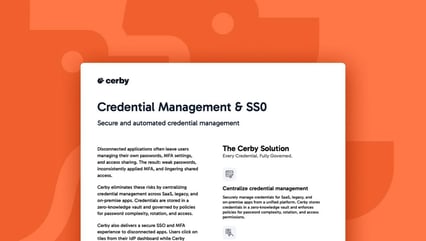
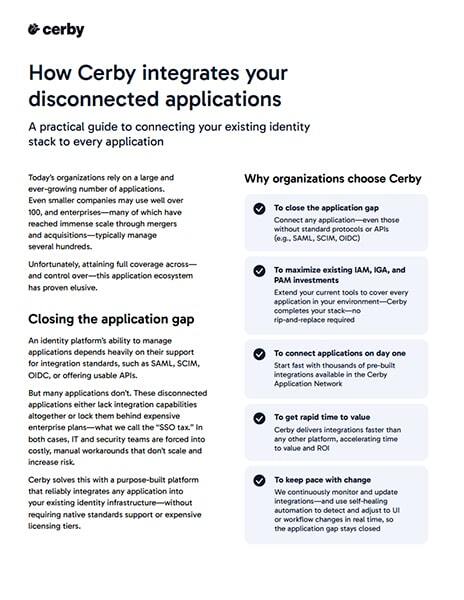
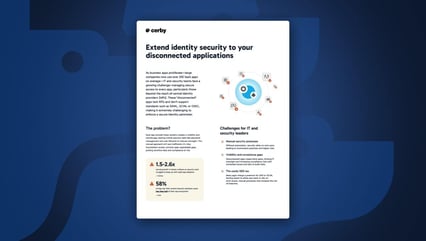
Cerby integrates the applications your identity tools can't reach: apps that don't support SAML, SCIM, or OIDC, or that lock those standards behind an expensive enterprise tier, the "SSO tax." It connects them through a purpose-built platform combining API operations, agentic AI, and UI automation, then extends your existing IAM, IGA, and PAM systems to cover them. Cerby completes your identity stack rather than replacing it, so disconnected apps come under the same access, lifecycle, and governance controls as the rest of your environment, with no rip-and-replace.
Most organizations run well over 100 applications, and many of them fall outside standard identity coverage because they lack integration capabilities or usable APIs. That forces IT and security teams into manual workarounds that don't scale and add risk. Cerby closes this application gap with thousands of pre-built integrations in the Cerby Application Network, and uses self-healing automation to detect and adjust to application UI or workflow changes so coverage doesn't break over time.
What the guide covers:
- Why applications become "disconnected" and what the SSO tax costs IT and security teams
- How Cerby connects apps with no SAML, SCIM, OIDC, or API support
- How Cerby extends existing IAM, IGA, and PAM investments instead of replacing them
- The Cerby Application Network and pre-built integration coverage
- The four-phase integration process, from requirements through continuous monitoring
Download the full solution brief: Cerby Application Network Solution Brief (PDF)